
What is turnkey manufacturing, and how can Total Precision help simplify your supply chain?
Bringing a product to market can involve far more than making a single component. There may be designs to review, tooling to create or transfer, plastic parts to mould, metal parts to press, inserts to position, assemblies to complete, tests to carry out and packaging to prepare.
When each stage is managed by a different supplier, the gaps between them can quickly become the hardest part of the project. More purchase orders, more transport, more handovers and more opportunities for delays or inconsistent quality all add pressure to the supply chain.
Turnkey manufacturing offers a more connected route. By bringing the required processes together through one accountable manufacturing partner, businesses can move from an initial concept, drawing or existing tool to a tested, assembled and customer-ready product with far less complexity.
At Total Precision, that joined-up approach is central to what we do. From our manufacturing facility in Ilkeston, Derbyshire, we support clients with individual precision components, several connected production processes or a complete turnkey manufacturing solution.
What does turnkey manufacturing mean?
Turnkey manufacturing means one partner takes responsibility for coordinating the processes required to turn an idea or specification into a finished product.
The exact route will differ from project to project. For one client, it may involve reviewing an existing mould tool and beginning repeat production. For another, it could combine precision metal pressing, insert moulding, electrical testing, assembly and branded packaging.
The important point is that the client does not have to manage every stage as a separate project. The manufacturing route is planned as one connected process, with clear ownership from the initial review through to final delivery.
It is also flexible. Turnkey support does not mean every project has to begin with a blank sheet of paper or use every service available. A business can approach Total Precision with:
an early product idea;
a finished drawing or specification;
an existing mould or press tool;
a component ready to move into production;
several parts that need assembling and testing; or
a product that requires packing under its own brand.
The right manufacturing route is then built around the actual requirement.
A complete route from concept to customer-ready product
Total Precision combines a broad range of manufacturing capabilities, allowing multiple stages of a project to be managed through one UK partner.
Product design and tooling
Early manufacturing input can help identify potential problems before they reach production. Product design support, design-for-manufacture reviews and suitable tooling decisions can improve repeatability, reduce avoidable costs and create a more reliable route to scale.
Support can begin with a concept, sample or technical drawing. It can also include the assessment and transfer of an existing tool when a client needs to move production to a new UK manufacturing partner.
Plastic injection moulding
Plastic injection moulding provides a repeatable and efficient way to manufacture precision components in both lower and higher volumes.
Total Precision works with a range of engineering polymers, including nylon, PBT, ABS, polypropylene, HDPE, POM and PPS, depending on the component’s performance requirements.
Horizontal, vertical and specialist moulding configurations allow the team to support a wide variety of parts, from straightforward moulded components to more complex applications involving metal inserts.
Precision metal pressing
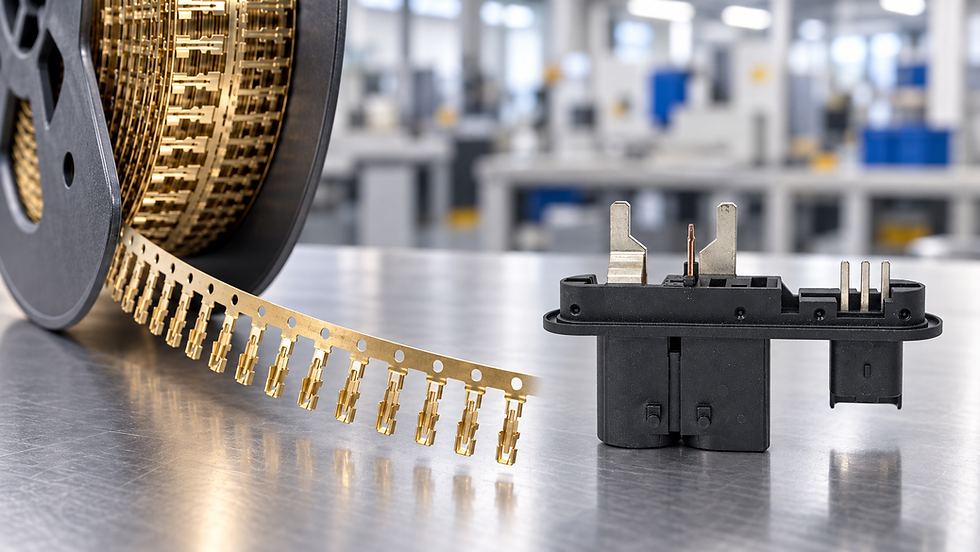
Where a product requires metal contacts, terminals, tabs, leadframes or other small pressed parts, precision metal pressing can form another stage of the same manufacturing programme.
Total Precision can produce single parts and reel-to-reel components from materials including steel, stainless steel, brass and copper, with material thicknesses ranging from 0.1 mm to 4 mm.
Where specialist plating or finishing is required, trusted external processes can be coordinated as part of the wider supply chain.
Insert moulding and overmoulding
Insert moulding and overmoulding combine different materials within one engineered component.
A metal contact, terminal, pin or leadframe is placed into a tool before plastic is moulded around it, creating a secure and repeatable finished part.
This approach is widely used in electrical and electronic applications because it can reduce separate assembly operations, protect critical elements and create a consistent interface between metal and plastic.
Total Precision has experience producing stamped metal parts in-house, overmoulding them and then carrying out the required inspection or electrical testing. That connected capability is a strong example of turnkey manufacturing in practice.
CNC pin and terminal insertion
For connectors, PCB-related products and other technical assemblies, CNC pin and terminal insertion provides a controlled way to place through-hole pins or stamped terminals into plastic or PCB substrates.
Combining insertion with moulding, metal pressing and assembly gives clients a clearer route through projects that might otherwise require several specialist suppliers.
Assembly, testing and inspection
A component may be dimensionally correct but still needs to perform properly within the finished product. That is why assembly, testing and quality control should be considered part of the manufacturing route rather than treated as an afterthought.
Total Precision supports manual and automated electro-mechanical assembly, bringing together parts manufactured in-house with approved externally sourced components where required.
Purpose-built processes can include electrical, electronic and mechanical testing, as well as leak-decay and flow-rate testing for suitable applications.
Quality checks are built into production through first-off, in-process and last-off inspection. Total Precision is third-party accredited to ISO 9001:2015, supporting a consistent and documented approach to quality management.
Packaging and white labelling
Manufacturing does not always end when the product leaves the assembly bench.
Total Precision can also prepare completed products for onward sale or distribution by adding instructions, sealing and boxing items, and applying the client’s own branding.
This white-label manufacturing service allows a business to receive a finished product that is ready for its customer, rather than a collection of components that still need to be coordinated elsewhere.
Why choose a turnkey manufacturing partner?
Fewer suppliers and handovers
Every handover introduces another point to manage. Bringing connected processes together reduces the number of separate suppliers, deliveries and production schedules involved in a project.
Clearer accountability
When one partner understands the complete manufacturing route, it is easier to identify priorities, solve problems and keep communication clear.
Clients have one team coordinating the work rather than having to establish where responsibility sits between several suppliers.
More consistent quality
Planning manufacture, inspection, assembly and testing as one process helps maintain consistent standards throughout production.
It also allows practical feedback from later stages to improve the way components are manufactured earlier in the process.
Reduced supply-chain risk
Fewer disconnected stages can mean fewer delays, less transport between suppliers and better visibility across the project.
When an approved specialist process is required externally, it can be managed as part of the complete programme rather than left as another task for the client.
Faster problem-solving
Manufacturing challenges rarely fit neatly into one category.
A moulded component may affect an assembly operation, a metal pressing may need to meet an electrical testing requirement, or the packaging may influence the finished design. A multidisciplinary team can consider these relationships earlier and respond more quickly when changes are needed.
Flexibility at every project stage
Turnkey manufacturing is not limited to new product development. It can support repeat production, transferred tooling, supply-chain consolidation, assembly-only projects and the development of existing products.
Clients can use one capability or combine several, depending on what the project requires.
Manufacturing support across multiple sectors
The same connected manufacturing principles can be applied across a wide range of industries.
Total Precision supports projects in electronics and sensing, windows, doors and decking, brewing and dispense, rail, selected automotive and off-highway applications, medical and breathing equipment, telecommunications and other engineered markets.
Examples include moulded connector components for temperature-monitoring equipment, small fittings and hardware for window and PVC decking systems, assembled products for brewing and dispense, and pressed and overmoulded contacts for electrical applications.
These projects may look very different, but they share the same need for repeatable manufacture, dependable quality and a supply partner that understands how individual parts contribute to the finished product.
When should you speak to a turnkey manufacturer?
It is worth starting a conversation when:
too many separate suppliers are making a project difficult to manage;
a product requires both plastic and metal components;
an existing tool or production programme needs transferring;
components need assembly, inspection or performance testing;
a recurring quality issue requires a wider manufacturing review;
you want to reduce supply-chain handovers; or
you need a finished product packed under your own brand.
You do not need to have every answer before making contact. A drawing, sample, existing tool or clear explanation of what the product needs to do can provide a useful starting point.
Frequently asked questions about turnkey manufacturing
Can Total Precision provide one process without managing the complete project?
Yes. Clients can use a single capability, such as plastic injection moulding or precision metal pressing, or combine several services into a complete turnkey manufacturing solution.
Can an existing mould tool be transferred to Total Precision?
Yes. Existing tooling can be reviewed for transfer and repeat production. The team can assess the tool, component requirements and any related assembly, testing or packaging needs before agreeing the production route.
Can Total Precision manufacture both plastic and metal parts?
Yes. Total Precision combines plastic injection moulding with in-house precision metal pressing, as well as insert moulding and overmoulding where metal and plastic need to form one component.
Can completed products be packed in our branding?
Yes. Total Precision can support assembly, instructions, sealing, boxing and white-label packaging so that suitable products are prepared for onward sale or distribution under the client’s brand.
What information is useful for an initial manufacturing review?
Drawings, CAD files, photographs, samples, material requirements, expected volumes and details of any existing tooling are all helpful.
If these are not yet available, start with the product idea, performance requirement or manufacturing challenge.
Bring us the part, the drawing or the challenge
Whether you need one precision component, several manufacturing processes brought together or a fully assembled and customer-ready product, Total Precision can build a practical route around your requirement.
Talk to our team about your next UK manufacturing project and discover how one accountable partner could take it from concept to complete solution.
Comments